
Cover art by Damian Mendez Romera.
The Facebook app does something odd as soon as I open it: it blocks the scrollbar in my feed. As in, I can’t continue scrolling down unless I finish watching the ad Meta decided to show me. The Instagram app is doing the same thing, my feed won’t scroll after a couple of videos unless I finish watching an ad.
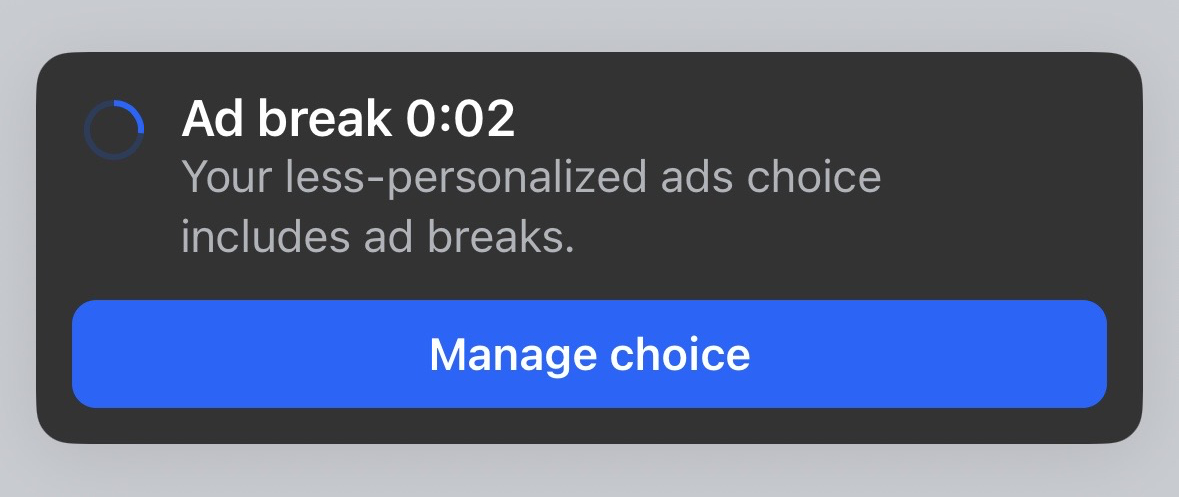
Facebook Ad-break. The app won’t let you scroll past this point until the ad finishes.
What’s surprising about this business decision from Meta, the decision to block me from using the app unless I watch an ad, is that I was supposed to be the product, i.e., they would farm people like me to harvest my attention. They wanted me to keep the app open and scrolling, watching meaningless video after meaningless video, with the idea that other companies would see some value in it and would pay Meta to insert an ad every few videos. The idea of me wanting to close the app because I can’t use it at all until the ad finishes goes in the opposite direction. They seem to be helping me recover from my doom-scrolling problem! Whenever my app gets blocked, I immediately close it and go on with life.
Very recently, WhatsApp started experimenting with the freemium model. An app that is now considered essential for personal communication and work (though if you have to use it for work, I’m very sorry for you) showed me a screen prompting me to sign up for a subscription that would allow me to have a few niceties in the app, like setting a theme, better stickers and such. None of the premium features are going to make me more productive or effective at sending messages, yet, but it’s just a matter of time until a middle manager who wants to improve the revenue numbers starts putting essential stuff in the premium subscription: things that are going to be considered a must for using WhatsApp for work. Coming from the same company that makes the Facebook and Instagram apps, it wouldn’t be surprising if they made you watch an ad every once in a while when you want to start a conversation. And how long would it be until they start hiding old messages unless you pay for the subscription? The monetization opportunities for a product so widely distributed across the world are just endless.
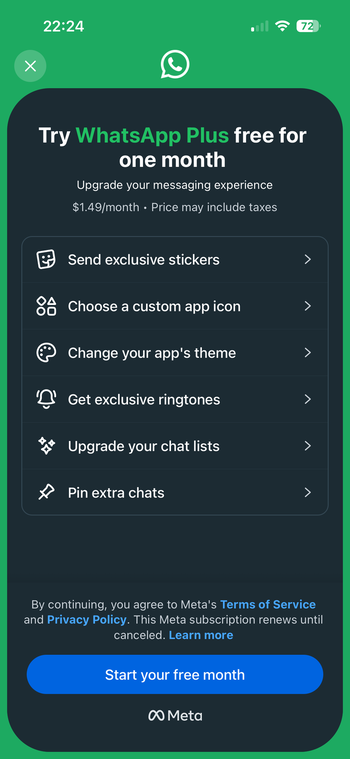
New freemium model for WhatsApp: pay for a few extra features.
But I don’t want to fixate on Meta; I want to focus on how this is an industry-wide situation. The tendency of this industry to enshittify its products is permeating all these services. In Adobe’s software, for instance, professionals are fleeing after years of making their subscription model more aggressive. Uber also offers a subscription, but the final price for a ride depends on the upsells they manage to sell you: a priority service, a large cab, the high-demand fee, etc. The moment you see a price for a ride in the Uber app is rarely the final price you’ll pay after considering the add-ons. Prime Video does something that’s extremely infuriating: they show you movies and shows that are on the platform that you’re already paying for, but in order to watch them you have to pay separately, per show or movie. Similar examples can be found for products from Microsoft and other big tech companies.
And here’s where I wonder: how long is it going to be until we start seeing these practices in AI companies? It’s already happening in a few limited scenarios, like OpenAI offering ChatGPT under an almost-freemium model (pay a little, see some ads). But I take this as a way to test the waters. Considering that, due to ongoing computing costs, flat-rate AI subscription pricing is doomed in the medium term, it won’t be long until sales managers realize they aren’t showing you enough ads, and find a way to insert ads into your paid subscription, even though you might be paying for the most expensive one. The current flat-rate AI subscription model will only survive under some sort of “pay-to-see-fewer-ads” model, because there will be no other way of making it profitable.
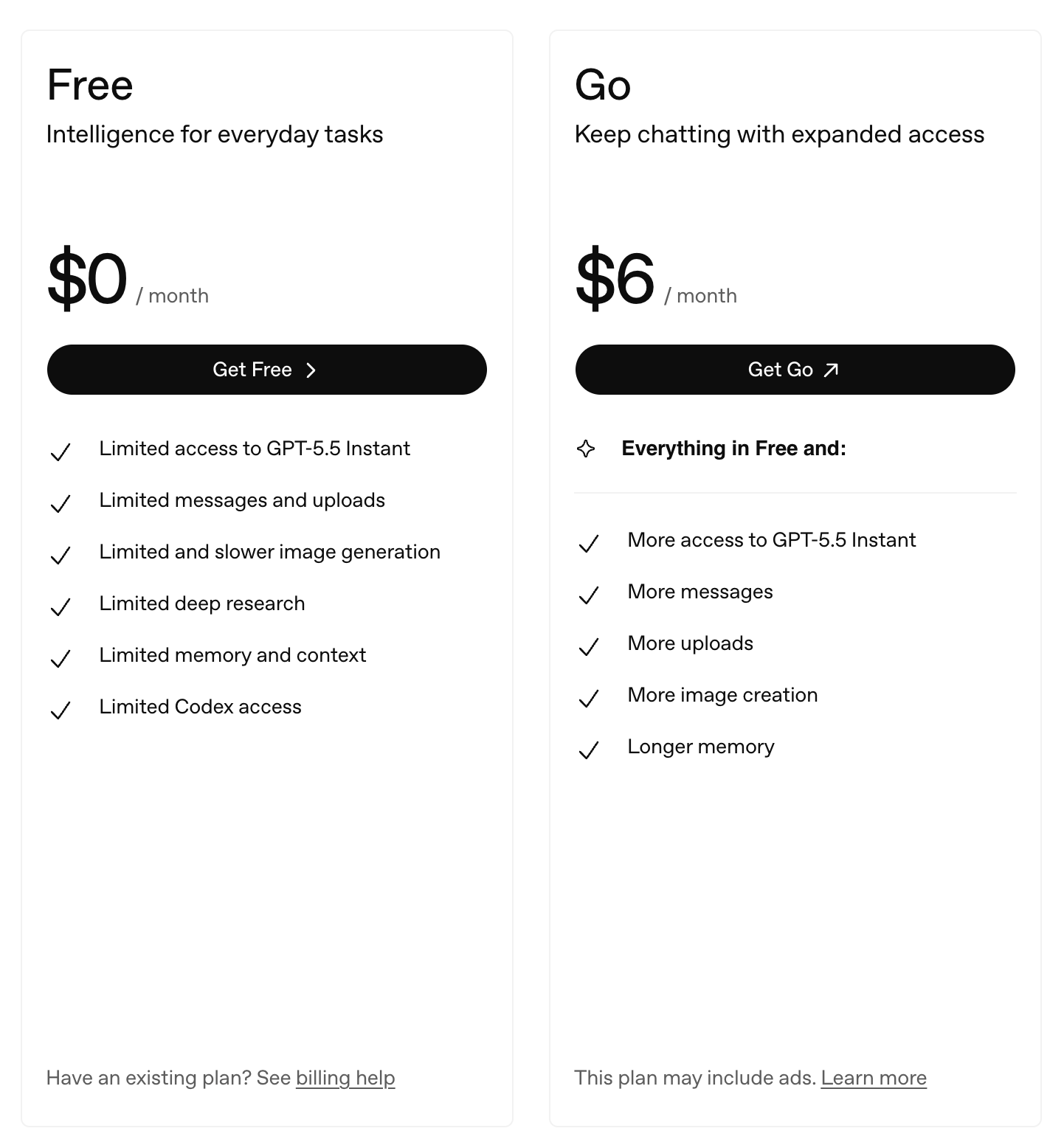
ChatGPT Go: the paid Go plan still shows ads.
In the good old days, Google was an infinite source of discovery and awe. Knowing all the tricks to make your query find the right resource was considered a top-notch skill. People were proud of having good Googling skills, because it effectively made a difference when using the Internet. These techniques were rapidly forgotten with the rise of dark-pattern SEO and Google’s willingness to sacrifice the usefulness of its main tool so that they could sell companies the idea that users only relied on Google to find stuff. The result after a few years of this model is that nowadays nobody uses Google to do deep research on obscure topics anymore. The data may exist, but you won’t find it with Google, because the tool is so rigged and skewed that you will only find whatever an SEO expert wanted to rank at the top of the results. Google let them do that, because it was convenient and profitable, and probably because some mid-level employee managed to convince a bunch of people internally that increasing revenue like this was acceptable.
It’s next to impossible to think that AI companies will be immune to this problem. This tendency of self-destroying the usefulness of your system is an odd disease that seems to be widespread across the industry. I can’t imagine this won’t happen in AI tools, especially the harnesses, which are what drive the LLMs toward successful execution. It will not be long until we start seeing the AI harnesses suggest that you use the Database-in-the-Cloud Company that paid to appear as the first option whenever a new database is needed in your code. Worse yet, I don’t see why Meta’s AI (or any other company) won’t make you watch an ad before giving you an answer, because it’s what Meta’s doing across all of its apps at the moment. All of this is made even worse by the fact that we’re feeding these companies all of our documents, thoughts, fears and ideas.
I’m in constant awe at what LLMs have brought us in terms of speed and how they act as a force multiplier when used cleverly, but previous experiences with disruptive technologies that shaped society (like the Internet, search engines and social networks) show us that these will inevitably be turned into ad-selling machines, enshittified like everything before them.